
Compliance
Care Label Compliance: FTC vs EU vs Japan (2026)
If your garment ships to more than one country, your care label has to clear four moving targets: fibre disclosure, care symbol set, language requirement, and country-of-origin format. Get one wrong and the freight gets held at customs.

Long Bingbing
Senior Production Engineer · 11 min read · Updated May 2026
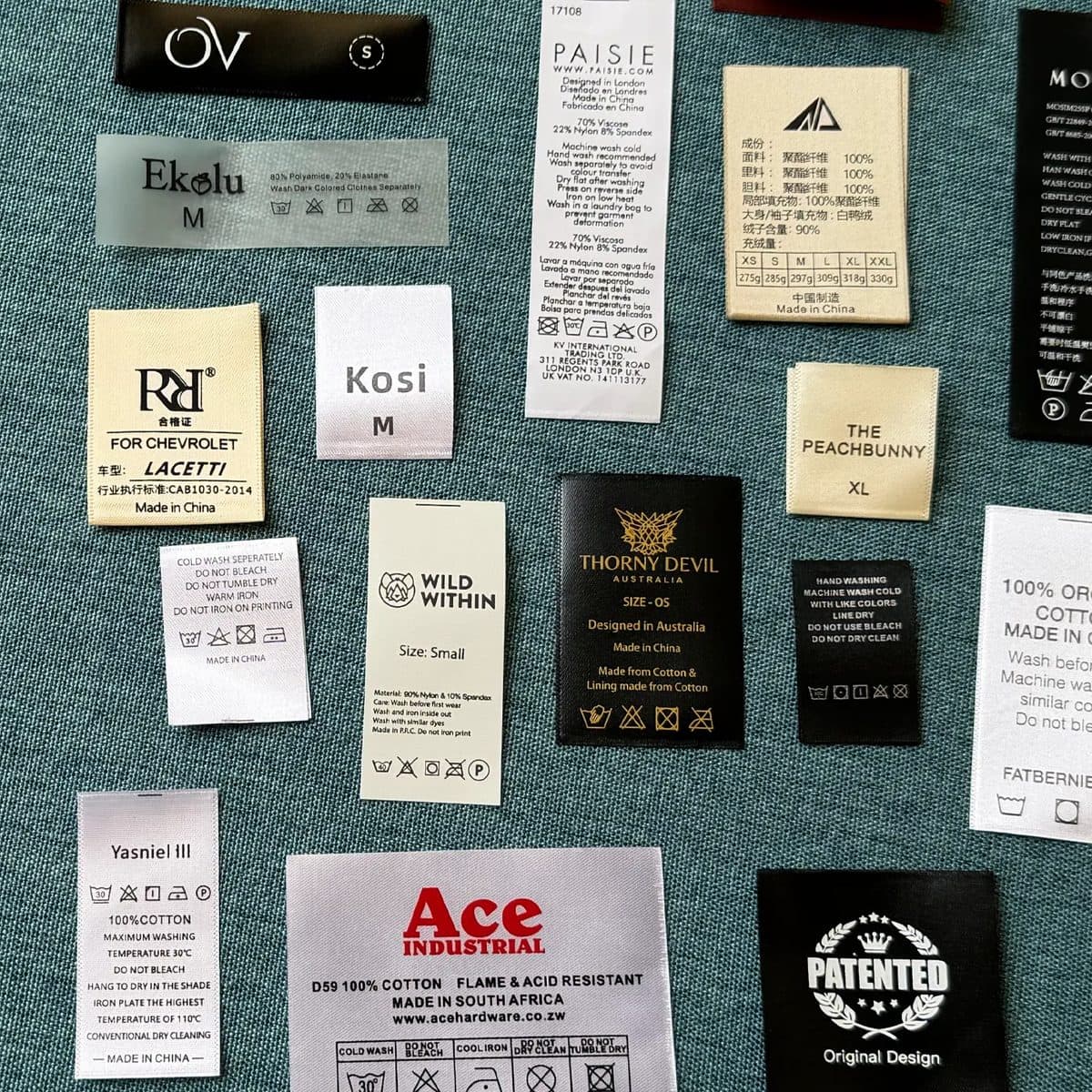
1. Why care label compliance is a customs problem first
A care label is not a marketing surface. In the US, EU, Japan and Canada it's a regulated disclosure — wrong content (or missing content) is grounds for customs to refuse the shipment, levy fines, or force a relabel-on-import. The four pillars almost always required:
- Fibre composition — declared by weight, descending order, exact percentages.
- Care symbols — using the symbol set the destination country recognises (ISO/GINETEX, ASTM, JIS).
- Country of origin — phrased exactly as the destination country requires.
- Language — written in the official language(s) of the destination market, not just English.
2. United States — FTC 16 CFR 423
Under the FTC Care Labeling Rule (16 CFR Part 423), every textile garment sold in the US must carry a permanent care label with at least one valid wash, bleach, dry, iron and dry-clean instruction. Symbols must conform to ASTM D5489-18 (closely aligned with ISO but with US-specific dot-and-line conventions). The label must remain legible for the useful life of the garment.
- Mandatory fields: care instructions, fibre content (under the Textile Fiber Products Identification Act), country of origin (US Customs requirement, not FTC), RN number or manufacturer name.
- Symbol set: ASTM D5489 — the US-specific care symbol standard. Wording is acceptable in lieu of symbols but symbols save space on multi-language labels.
- Language: English. Spanish optional.
- Permanence: must survive 10+ wash cycles minimum without becoming illegible.
3. European Union — Regulation 1007/2011 + ISO 3758
The EU's textile regime is split: fibre content is regulated by Regulation (EU) 1007/2011 (mandatory disclosure in the official language(s) of every member state where the product is sold), and care symbols follow EN ISO 3758:2023 voluntarily — but if you use symbols, they must be the GINETEX/ISO set (no national variants).
- Mandatory fields: fibre composition, country of origin (recommended, not strictly required EU-wide), CE-relevant safety markings if applicable (e.g., children's wear under EN 14682 cord/drawstring rules).
- Symbol set: EN ISO 3758:2023 (revised April 2023). GINETEX is the licensing body — symbols are technically trademarked.
- Language: Language(s) of every country you ship to. France-only? French. Belgium? French + Dutch + German. Pan-EU? Use symbols instead of words to avoid translating.
- Chemical safety: REACH SVHC compliance is mandatory for the substrate itself (no AZO dyes, no DEHP plasticisers, etc.). OEKO-TEX Standard 100 satisfies most of this in one stamp.
| Country | Required language(s) |
|---|---|
| Germany / Austria | German |
| France | French |
| Italy | Italian |
| Spain | Spanish (Castilian) |
| Belgium | French + Dutch + German |
| Netherlands | Dutch |
| Sweden | Swedish |
| Finland | Finnish + Swedish |
| Pan-EU | Use ISO symbols only (no language) — fastest path |
4. Japan — JIS L 0001:2024
Japan revised its care labelling standard on 20 August 2024, replacing the 2014 version. JIS L 0001:2024 is now fully aligned with ISO 3758:2023 — same symbols, same dot conventions. The historical Japan-only square iron and bucket-with-hand symbols are obsolete; if you're using cached artwork from before 2016 you must redraw.
- Mandatory fields: fibre composition, care symbols (JIS L 0001:2024), country of origin, importer / brand name and address (if Made in Japan: manufacturer name).
- Language: Japanese, mandatory. Bilingual JP/EN labels are accepted by most retailers.
- Symbol position: wash → bleach → dry → iron → dry-clean → professional wet-clean (left to right is convention but not legally required).
- Legal basis: Household Goods Quality Labeling Act (家庭用品品質表示法) administered by the Consumer Affairs Agency.
5. Canada — Textile Labelling Act
Canada's Textile Labelling Act (administered by Competition Bureau) requires fibre composition in English and French (so-called 'mandated bilingual'), descending order by weight. Care symbols are voluntary but if used must follow the CAN/CGSB-86.1 standard, which mirrors ISO 3758. Country of origin is required by the Customs Act, separate piece of legislation.
- Mandatory fields: fibre content (EN + FR), CA Identification Number (CA Number) OR registered name and full address of dealer.
- Language: English AND French — both, not either.
- Symbol set: CAN/CGSB-86.1 (mirrors ISO).
6. The pragmatic global strategy
If you sell in 4+ markets, don't fight regulators with one universal label — that's how artwork files balloon to 8 lines of microtype. Instead use a hub-and-spoke structure:
Decision flow: how many label variants do you actually need?
- 1Single-market launch (US-only, JP-only, …)→ 1 variant in local language + local symbol set
- 2Pan-EU launch→ 1 variant: ISO 3758 symbols + REACH/OEKO-TEX certification stamp on substrate
- 3US + EU + Canada→ 2 variants: NA bilingual (EN/FR), EU symbol-only
- 4Add Japan / Korea / China→ +1 Asia variant: ISO 3758 symbols + local language fibre content
Most factories (us included) keep your woven brand main on one global SKU and split only the printed care label per region. That keeps inventory complexity low while maintaining compliance.
7. Top reasons we see labels rejected at port
- Fibre percentages don't add to 100 % — most common cause: forgot to add elastane to the rounding. Fix: spec ±0 % tolerance with the lab.
- Country of origin in wrong format — US wants 'Made in [Country]', EU accepts 'Origine [Country]' in local language, Japan wants '原産国'. Don't translate freely; use the legally-recognised phrasing.
- ASTM symbols mixed with ISO symbols — using a 'P' inside the dry-clean circle (ISO) on a US label that expects ASTM 'A/P/F' wording. Pick one set per market.
- Care symbols printed too small — the US FTC requires legibility 'with normal eyesight'. The practical floor is 4 mm symbol height, 6 mm if printed on dark satin.
- Removed labels — temporary stick-on labels are not 'permanently affixed'. Care labels must be sewn or thermally bonded so they survive consumer washing.
8. Pre-production checklist
| Item | US (FTC) | EU | Japan (JIS 2024) | Canada |
|---|---|---|---|---|
| Fibre content with % | ✔ Required | ✔ Required | ✔ Required | ✔ EN + FR required |
| Care symbols | ASTM D5489 (or words) | EN ISO 3758:2023 | JIS L 0001:2024 (= ISO) | CAN/CGSB-86.1 (= ISO) |
| Country of origin | ✔ (Customs) | Recommended | ✔ | ✔ |
| Language | EN | Local language(s) or symbols | Japanese | EN + FR |
| Brand/dealer name + ID | RN # or name | Recommended | Importer name+address | CA # or name+address |
| Substrate chemical safety | CPSIA (kids) | REACH SVHC + OEKO-TEX | JIS Toxic Substance Control | CCCR (cribs/sleepwear) |
References
- FTC — 16 CFR Part 423 Care Labeling Rule
- ISO 3758:2023 — Care labelling code (revised)
- GINETEX — Origin and licensing of the international care symbols
- ASTM D5489 — US care symbol standard
- Intertek — JIS L 0001:2024 update bulletin
- EU Regulation 1007/2011 on textile fibre names & labelling
- ECHA — REACH SVHC candidate list
- Health Canada — Textile Labelling Act
Preguntas frecuentes
Can one care label work in every country I ship to?
Only if you stick to symbols and skip words — a symbol-only label using ISO 3758:2023 is compliant in EU and Japan and acceptable (with FTC supplementation) in the US. You'll still need a separate fibre-content disclosure in each region's language.
Do I have to use symbols or can I use words?
US: words alone are acceptable under FTC. EU & Japan: words are also acceptable but must be in the local language; symbols save translation labour. We recommend symbols for any brand selling in 3+ markets.
Where does the country-of-origin go?
FTC requires it on a permanent label visible to the consumer at point of sale. EU and Japan accept it on the same care label. Canada requires bilingual presentation (EN/FR). Do NOT print it only on the hang tag — hang tags are removed before wear.
What's the difference between OEKO-TEX and REACH?
REACH is EU law (mandatory) regulating Substances of Very High Concern (SVHCs) in the substrate. OEKO-TEX Standard 100 is a voluntary certification that proves you meet REACH and many other limits in one test pass. We recommend OEKO-TEX on every order regardless of destination.
How small can the symbols be printed?
The practical floor we use in production is 4 mm symbol height on white substrates, 6 mm on dark satin (where ink contrast is lower). FTC requires legibility 'with normal eyesight' — too small fails the test, too large wastes label real estate.
Do children's clothes have extra requirements?
Yes. US: CPSIA (Consumer Product Safety Improvement Act) limits lead and phthalates and requires tracking labels. EU: EN 14682 governs cords and drawstrings. Japan: stricter formaldehyde limits for ages 0–24 months. Always disclose substrate composition for under-3 wear.
Productos relacionados
Productos de fábrica mencionados en este artículo — pide una muestra gratuita o un presupuesto.
Sigue leyendo
¿No ve lo que necesita?
Hacemos personalización completa – cualquier forma, material o acabado. Envíenos su referencia y la creamos.
Solicitar cotización gratuita