
Materials
Woven vs Printed Labels: The 2026 Buyer's Guide
Choosing between a woven and a printed label decides how your garment is perceived in the first three seconds a customer touches it. Here is the trade-off, with numbers — not opinions.
Long Bingbing
Senior Production Engineer · 9 min read · Updated May 2026
1. How they're actually made
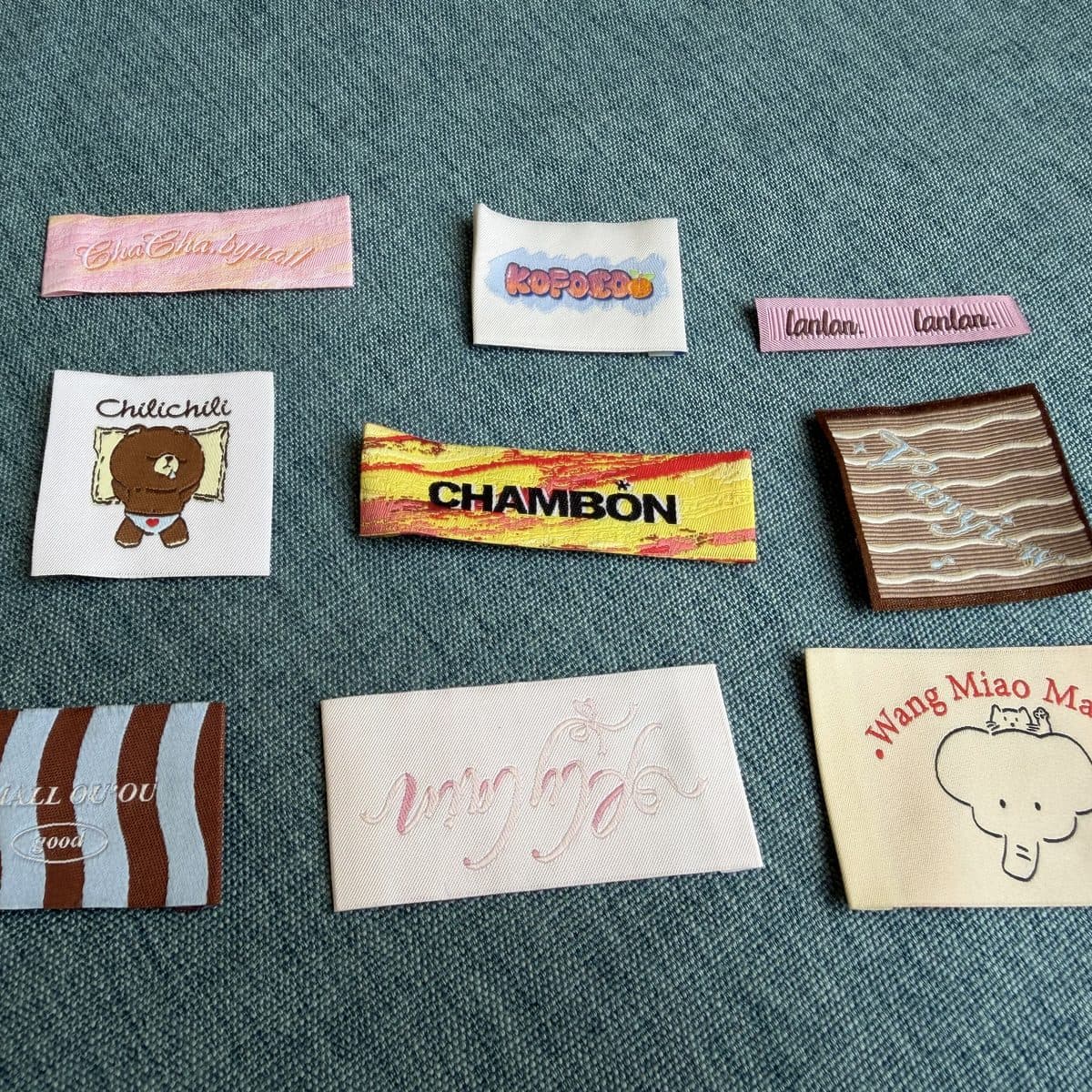
A woven label is built thread-by-thread on a high-density jacquard loom. The design is part of the fabric itself — there is no separate ink layer to wear off. A printed label starts with a base ribbon (usually satin polyester or cotton tape) and your artwork is applied on top, typically by thermal transfer, screen print, or digital sublimation.
2. Side-by-side comparison
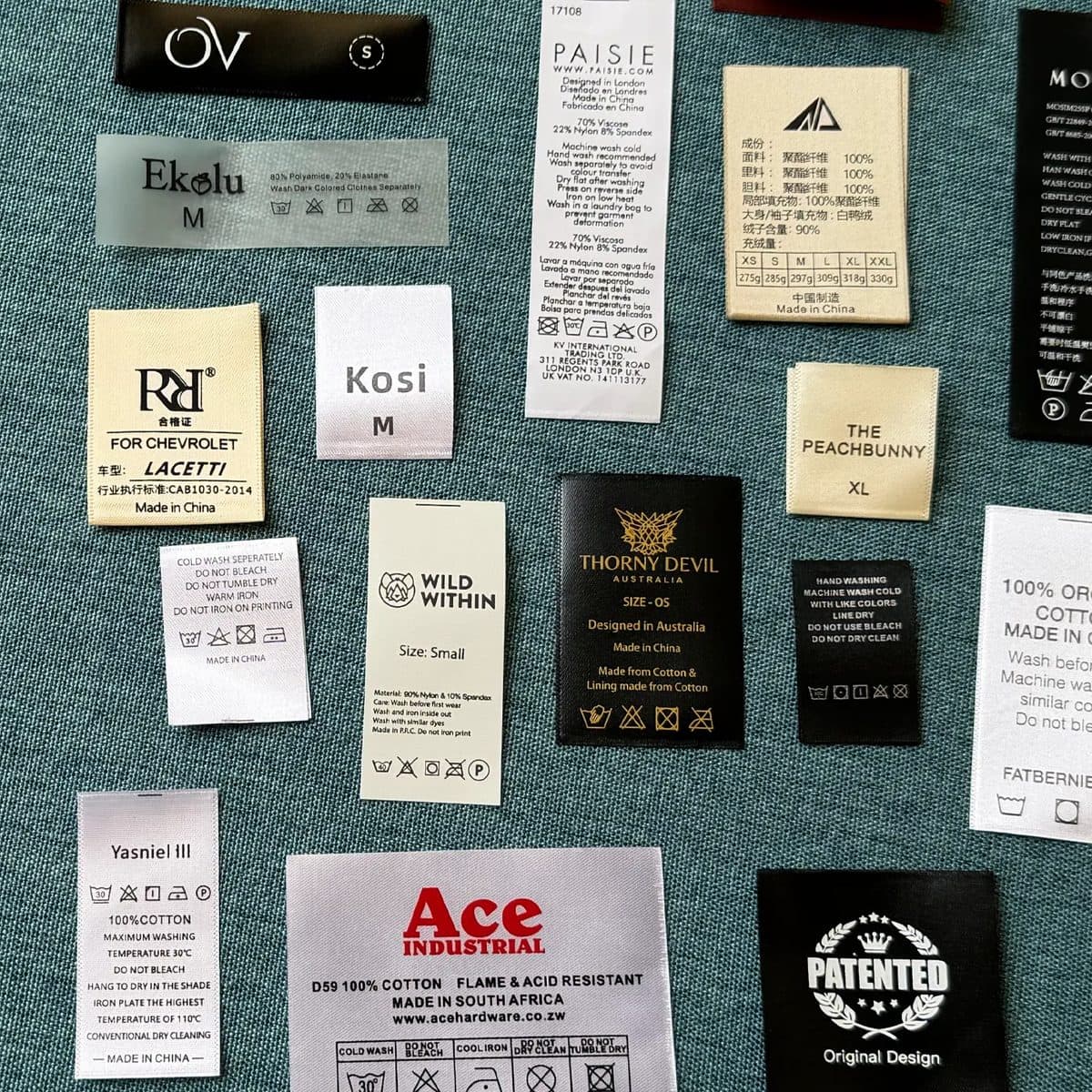
| Attribute | Woven label | Printed label |
|---|---|---|
| Hand feel | Premium, textured | Smooth, ink-on-fabric |
| Durability (wash cycles) | 100+ without fade | 30–60 (high-end thermal transfer up to 80) |
| Color count | Up to 8–12 thread colors | Unlimited (digital) / 8 spot (screen) |
| Smallest legible text | ~5 pt | ~3 pt with thermal transfer |
| Setup time | ~24h (loom rigging) | Same-day (digital file) |
| Standard MOQ | 100–500 pcs | 100 pcs |
| Unit cost @ 1,000 pcs | $0.04–0.08 | $0.02–0.05 |
| Photographic detail | Limited (no gradients) | Excellent (full CMYK) |
| Best for | Brand mains, neck labels, premium positioning | Care labels, multi-language wash content, complex graphics |
3. Durability under real wash cycles
Woven labels survive hundreds of industrial-laundry cycles because their design is structural — the colour comes from coloured yarn, not from a deposit on top. Printed labels rely on the bond between ink and substrate. With thermal transfer prints (the dominant method today) you can expect 50+ wash cycles at 60 °C without fading. With screen-printed labels the number is similar but edge-cracking starts earlier on stretchy fabrics.
- Hospitality & uniform programs (industrial wash, daily) → woven, no question.
- Fashion retail (consumer wash, ~50 cycles over a garment's life) → either; printed is acceptable for care labels.
- Children's wear & sportswear (stretchy fabric, frequent wash) → woven main label + printed care label, never solo printed on the neck.
4. The real cost picture
On small runs (under ~300 pieces) printed wins on price by 15–30 % because there is no loom setup cost. The crossover point is around 500 units: above that the woven setup amortises and unit costs converge. At 5,000+ pieces woven is often *cheaper* than full-colour digital print because no ink is consumed.
Decision flow: which one for your run?
- 1Quantity ≤ 300 pcs and design has gradients or photos?→ Printed (digital sublimation)
- 2Quantity 300–1,000 pcs and design has 1–8 colors, premium positioning?→ Woven (damask or satin)
- 3Quantity 1,000+ pcs and you ship to multi-language markets?→ Woven brand main + printed care label
- 4Children's wear or technical sportswear?→ Woven only (no print on next-to-skin areas)
5. Design limits you should plan around
Most brand artwork that fails on first sample fails because the designer expected print-quality detail in a woven format. Two rules:
- Woven: keep strokes ≥ 0.3 mm; avoid gradients; cap at 8 thread colours. Pantone matching is approximate (within 1 ΔE).
- Printed: keep type ≥ 4 pt for thermal transfer, ≥ 6 pt for screen print; under-print a white base if your artwork uses light colours on a dark substrate.
6. Regulatory & material compliance
Whichever method you pick, the substrate has to clear chemical-safety thresholds for the markets you ship to. For US, EU, and Japan that means OEKO-TEX Standard 100 (recommended on every order), plus REACH SVHC compliance for EU. Care symbols on the printed care label must follow ISO 3758 (also adopted by JIS L 0001 in Japan since 2024) or ASTM D5489 for US-only programs.
Practical implication: many brands use woven labels for the main brand mark and *separate* printed labels for care content. The woven part can be one global SKU; the care label varies per market because wash-symbol and language requirements diverge.
7. How premium brands actually use them
- Luxury denim: woven damask main label + woven size loop + small printed care strip in the side seam.
- Athletic/performance: heat-transferred main (no neck irritation) + printed care, both on stretch-bonded substrate.
- Sustainable basics (GRS-certified): woven main on recycled polyester yarn + printed care on 100 % recycled satin.
References
- FTC — Clothes Captioning: Care Labeling Rule (16 CFR 423)
- ISO 3758:2023 — Textiles, care labelling code using symbols
- GINETEX — International textile care symbols
- OEKO-TEX Standard 100 (chemical safety for textiles)
- ASTM D5489 — Care symbols for textiles (US standard)
- JIS L 0001:2024 — Japan care labelling revision (Intertek)
- EU Textile Regulation 1007/2011 — Fibre composition labelling
Frequently Asked Questions
Are woven labels really more durable than printed labels?
Yes. Woven labels last 100+ wash cycles without fade because the colour is in the yarn itself; high-end thermal-transfer printed labels last 50–80 cycles before edge wear is visible.
Can a printed label feel as premium as a woven label?
No. Hand-feel comes from texture, and printed labels have flat ink on a substrate. For premium positioning (luxury fashion, heritage brands) buyers consistently prefer woven.
What's the lowest MOQ for woven labels?
Most factories quote 500 pcs minimum because of loom setup. Specialised low-MOQ shops (including Jingyu Labels) accept 100 pcs at a small per-unit premium.
Should care labels always be printed?
Almost always. Care labels carry small text, multi-language content, and wash symbols — all of which are cheaper and clearer in print than in weave.
How long does it take to produce a sample?
Woven: 5–7 working days for the loom rig + sample. Printed: 2–3 days from approved artwork.
Related products
Production-grade products discussed in this article — request a free sample or quote.
Continue reading
Don't See What You Need?
We do full custom — any shape, any material, any finish. Send us your reference and we'll build it.
Request a Free Quote